

Renaissance Art Explained: How to See What Others Miss
The Renaissance introduced an idea that still defines modern masculinity: the belief that a man could cultivate strength and intellect simultaneously.
You’re standing in a museum, shoulder to shoulder with a quiet crowd, staring at a sculpture or painting you’ve seen a hundred times in books, screensavers, and Instagram feeds. You know it’s important. You know you’re supposed to feel something. And yet, there’s that lingering question: Why should Renaissance art matter to me?
The Renaissance introduced an idea that still defines modern masculinity: the belief that a man could cultivate strength and intellect simultaneously. This was the birth of the “Renaissance man”, someone fluent in art and science, aesthetics and discipline, beauty and mastery. The same era that produced iconic sculptures and paintings also laid the groundwork for modern architecture, luxury craftsmanship, tailored style, and even how we visualize the ideal male form.
To understand Renaissance art, then, is not merely to understand old paintings. It’s to trace the origin story of modern taste itself. The reason a tailored suit emphasizes proportion. The reason fitness imagery values balance over bulk is that it is more effective. The reason luxury still signals refinement rather than excess. Renaissance art transformed the visual expression of power, elegance, and ambition.
Learning how to see it properly doesn’t make you an art historian. It makes you perceptive. And for the modern man, perception is a form of advantage.
Renaissance Art in a Nutshell

If you want to understand Renaissance art without drowning in dates and trivia, think in three movements: Early, High, and Late. Each phase builds on the last, sharpening the tools that would redefine how the Western world sees itself.
Early Renaissance (14th–15th Century): The Awakening
The Early Renaissance, therefore, begins in Florence in the 1400s, a city where bankers, merchants, and ambitious dynasties like the Medici financed artists much the way venture capital backs innovators today. In that climate of calculated risk and cultural ambition, painters such as Masaccio and sculptors such as Donatello began to push boundaries, experimenting with linear perspective, anatomical accuracy, and emotional realism in ways that had been dormant for centuries.
As a result, something shifted. For the first time in generations, figures stood on believable ground rather than floating against abstract gold backdrops. Interiors receded convincingly into depth. Bodies carried weight, tension, and presence. However, this transformation was both technical and philosophical. By studying muscle, proportion, and spatial logic, artists were consciously reviving the ancient Greek and Roman conviction that the human being deserved disciplined observation and intellectual inquiry. In other words, the Early Renaissance re-centered the human experience itself.
High Renaissance (Late 15th–Early 16th Century): The Apex
Then, as momentum built, came the High Renaissance, roughly 1490 to 1520, centered primarily in Florence and, increasingly, in Rome. This is the era of Leonardo da Vinci, Michelangelo, and Raphael. They were the triumvirate whose names have become shorthand for artistic genius.
At this stage, the bold experimentation of the Early Renaissance gives way to disciplined mastery. Composition, once exploratory, now appears balanced and serene. Anatomy, once studied with curiosity, achieves heroic precision. Perspective now feels seamless, so natural that the engineering behind it disappears. Consequently, these works radiate a quiet authority. They are visual statements from a culture convinced it has deciphered proportion, beauty, and intellectual order.
Meanwhile, Rome, energized by the Church and emboldened by powerful popes, emerges as the grand stage for artistic ambition. The Vatican commissions sweeping fresco cycles and monumental sculptures not merely to adorn sacred walls, but to assert theological supremacy and political dominance. In this context, art becomes strategy. Beauty becomes persuasion. And the High Renaissance, therefore, stands not only as an artistic apex, but as a declaration of cultural confidence at its most formidable.
Late Renaissance (Mannerism): Complexity and Tension
After the High Renaissance’s apparent perfection, the Late Renaissance, often called Mannerism, pushes the rules further. Figures grow elongated. Poses twist into complexity. Colors intensify.
Where the High Renaissance sought harmony, Mannerism explores tension and artifice. It reflects a Europe wrestling with religious upheaval and political instability. Even in its distortion, however, it builds on the Renaissance breakthrough: the body remains central, expressive, and intentional.
Centers of Power: Florence, Rome, Venice
Renaissance art didn’t emerge in isolation. It flourished in cities where money, politics, and ambition intersected.
- Florence: The laboratory of innovation. Banking wealth fuels artistic experimentation.
- Rome: The epicenter of religious authority and monumental commissions.
- Venice: A maritime power whose painters, like Titian, emphasize color, luxury, and sensual atmosphere.
Beyond Italy, royal courts and the Catholic Church served as primary patrons. Art was power branding. A frescoed chapel or a commissioned portrait projected authority, refinement, and divine favor.
Humanism and the Rise of the Individual Genius
At the philosophical core of the Renaissance lies humanism: the belief that human potential, intellect, and creativity deserve celebration.
Medieval art often treated artists as anonymous craftsmen. The Renaissance elevates them to the status of named geniuses. Leonardo signs his work. Michelangelo negotiates contracts. Raphael builds a workshop empire.
The artist becomes a thinker, inventor, and brand. This shift continues to shape how we revere visionary founders, designers, and cultural icons.
Breaking from the Medieval World
To fully grasp the scale of the Renaissance revolution, it is helpful first to picture what came before it. Medieval art often relied on flat gold backgrounds, hieratic figures, and minimal depth. Its purpose was devotional rather than observational; it aimed to instruct the faithful rather than to mirror the physical world. Space functioned symbolically, and proportion bowed to theology.
By contrast, Renaissance art pivots decisively toward lifelike form and convincing spatial logic. Floors recede toward carefully plotted vanishing points. Landscapes stretch into hazy atmospheric distance. Meanwhile, muscles flex beneath skin that appears tangible, weighted, and anatomically precise. In place of abstraction, you encounter embodiment.
In short, the Renaissance replaces symbolic flatness with grounded reality. It transforms art from a spiritual diagram into something you can mentally step into, almost physically.
Moreover, in doing so, it quietly lays the foundation for modern realism across disciplines. Architecture begins to emphasize proportion and perspective. And later, fashion photography highlights the sculptural body. Film frames scenes through calculated depth. Even contemporary fitness imagery echoes Renaissance ideals of musculature and posture. Gradually, the world begins to appear three-dimensional not only on canvas but also within the cultural imagination itself.
What Distinguishes Renaissance Art?

You can spot Renaissance art across a crowded gallery without reading the placard, if you know what to look for. It has a distinct visual language: confident bodies, ordered space, sculpted light, and a quiet reverence for the classical world. More importantly, it feels intentional. Nothing is accidental. Everything serves structure, meaning, and authority.
Let us break down the core elements that define the appearance.
Realism and Anatomy: The Body as Statement
Renaissance artists studied the human form, quite literally. Through anatomical sketches, dissections, and close observation, they rendered bodies with convincing musculature, proportion, and weight. Shoulders rotate naturally. Hands flex with tension. Veins rise beneath the skin. Faces express interior thought rather than fixed symbolism.
Proportion becomes mathematics. Many artists leaned on classical ratios, echoing ancient Greek ideals, to create figures that feel balanced, heroic, and grounded. Even when depicting biblical figures or mythological gods, they looked unmistakably human.
The result? Movement feels plausible. Posture communicates character. The body becomes a vehicle for psychology, not just decoration.
Perspective and Space: Mastering Depth
Perhaps most dramatically, the Renaissance announced itself through the invention and refinement of linear perspective.
Prior to this breakthrough, paintings often appeared visually flat. Figures were stacked vertically, one above another, rather than grounded within believable environments. Depth felt symbolic rather than structural. However, Renaissance artists fundamentally altered that visual logic by introducing vanishing points and carefully calculated converging lines, thereby creating the illusion of three-dimensional space on a two-dimensional surface.
As a result, scenes began to breathe. You notice tiled floors receding convincingly into the distance. Archways narrow toward a precise central point. Meanwhile, landscapes fade gradually into layered horizons, drawing the eye inward and forward simultaneously. Every line serves intention; every angle reinforces order.
Importantly, this was not merely a technical flourish. Rather, it signaled a profound shift in worldview. The Renaissance placed humanity at the center of an ordered, rational universe, and perspective visually reinforced that philosophy. Space became logical. It became navigable. Above all, it became controlled.
Light and Shadow: Sculpting with Paint
Light in Renaissance art is architectural. Through chiaroscuro, the dramatic interplay of light and shadow, artists gave figures weight and volume. Faces emerge from darkness. Drapery folds with dimensionality. Muscles appear carved from marble, even when rendered in oil or fresco.
Beyond close-range modeling, artists also experimented with atmospheric perspective: distant hills soften and turn bluish, mimicking how light behaves in nature. The farther away something is, the less distinct it becomes.
In short, light becomes a tool for directing attention and shaping emotional tone. It guides the eye the way a cinematographer frames a scene.
Classical Influence: Borrowing from Rome and Greece
Renaissance art, importantly, consciously resurrected the classical world. Throughout paintings, frescoes, and sculptures, columns, arches, domes, and coffered ceilings deliberately reference ancient Roman architecture. Likewise, draped togas echo the marble sculptures of Greek heroes, while mythological scenes: Venus, Mars, Apollo, reappear confidently alongside biblical narratives. In effect, sacred and classical imagery coexist, reinforcing a broader intellectual ambition.
Yet this revival was not mere nostalgia; rather, it was strategic alignment. Classical antiquity symbolized rationality, civic virtue, physical strength, and intellectual discipline. Therefore, by visually quoting Rome and Greece, Renaissance artists and their patrons intentionally aligned themselves with that powerful legacy. They were not simply borrowing aesthetics; they were claiming inheritance.
Consequently, the message was unmistakable: we are not living in the shadows of the past; rather, we are reviving, refining, and advancing it.
Expanded Subject Matter: Beyond the Sacred
While medieval art focused almost exclusively on religious themes, the Renaissance broadened the lens.
Yes, biblical scenes remain central. However, new genres flourish:
- Portraits of merchants, nobles, and thinkers—celebrating individuality.
- Mythological scenes drawn from Ovid and classical literature.
- Contemporary life is subtly woven into sacred stories with modern clothing, recognizable cityscapes, and familiar architecture.
Art begins to reflect lived experience, ambition, and identity. This shift mirrors the Renaissance belief that human life, with its intellect, ambition, beauty, and complexity, is worthy of attention.
The Unifying Thread
What ultimately makes Renaissance art feel distinctly “Renaissance,” however, is deliberate, disciplined control of anatomy, space, light, and narrative. In other words, nothing is left to chance; every element is calibrated.
Rather than simply applying paint to a surface, these artists were, in effect, constructing visual systems. Systems rooted in close observation, reinforced by mathematics, inspired by classical ideals, and sharpened through psychological insight. Consequently, each composition feels less like decoration and more like a structured, intentional, and intellectually grounded design.
And it is precisely that measured, composed, and deliberate confidence that continues to resonate with modern men today. After all, Renaissance art presents a world in which intellect and physicality align, in which form serves purpose rather than excess, and in which mastery is evident in every carefully rendered detail.
The Big Names Every Man Should Know
The Renaissance produced dozens of masters. However, a handful of names continue to anchor the entire period. To understand Renaissance art, and by extension, the blueprint of modern cultural sophistication, you need to understand the men who defined it.
Leonardo da Vinci: The Mind as Muscle

If the Renaissance had a patron saint of intellect, it would be Leonardo da Vinci. Painter, engineer, anatomist, and inventor, Leonardo embodies the archetype of the “Renaissance man” long before the phrase became cliché.
In works such as The Last Supper and the Mona Lisa, what stands out first is subtlety. Faces shift with psychological nuance. Hands communicate tension and intention. Light dissolves edges in a technique known as sfumato, creating atmosphere rather than hard outlines.
Yet beneath that elegance lies obsession. Leonardo dissected cadavers to understand musculature. He sketched water currents, weapon designs, and flying machines. He studied how light bends across surfaces. In other words, he treated art as a science of seeing.
For modern men, Leonardo represents the idea that mastery comes not from specialization alone, but from curiosity applied relentlessly.
Michelangelo: The Body as Monument

If Leonardo represents the analytical mind, Michelangelo represents physical and emotional force. His David is not merely a statue; it is a manifesto carved in marble. Every vein, every tendon, every twist of posture communicates contained power.
Likewise, the Sistine Chapel ceiling, particularly the Creation of Adam, pulses with muscular drama. Figures strain, reach, and coil with an almost architectural tension. Michelangelo elevates the human body into a vehicle of divine intensity.
Importantly, his bodies are not passive. They dominate space. They command attention. They appear heroic, even when vulnerable.
In today’s language, Michelangelo shapes the visual vocabulary of strength and discipline. Fitness photography, athletic branding, and even tailored suiting that emphasizes the shoulder and torso all echo Renaissance proportions refined under his chisel.
Raphael: Harmony as Authority
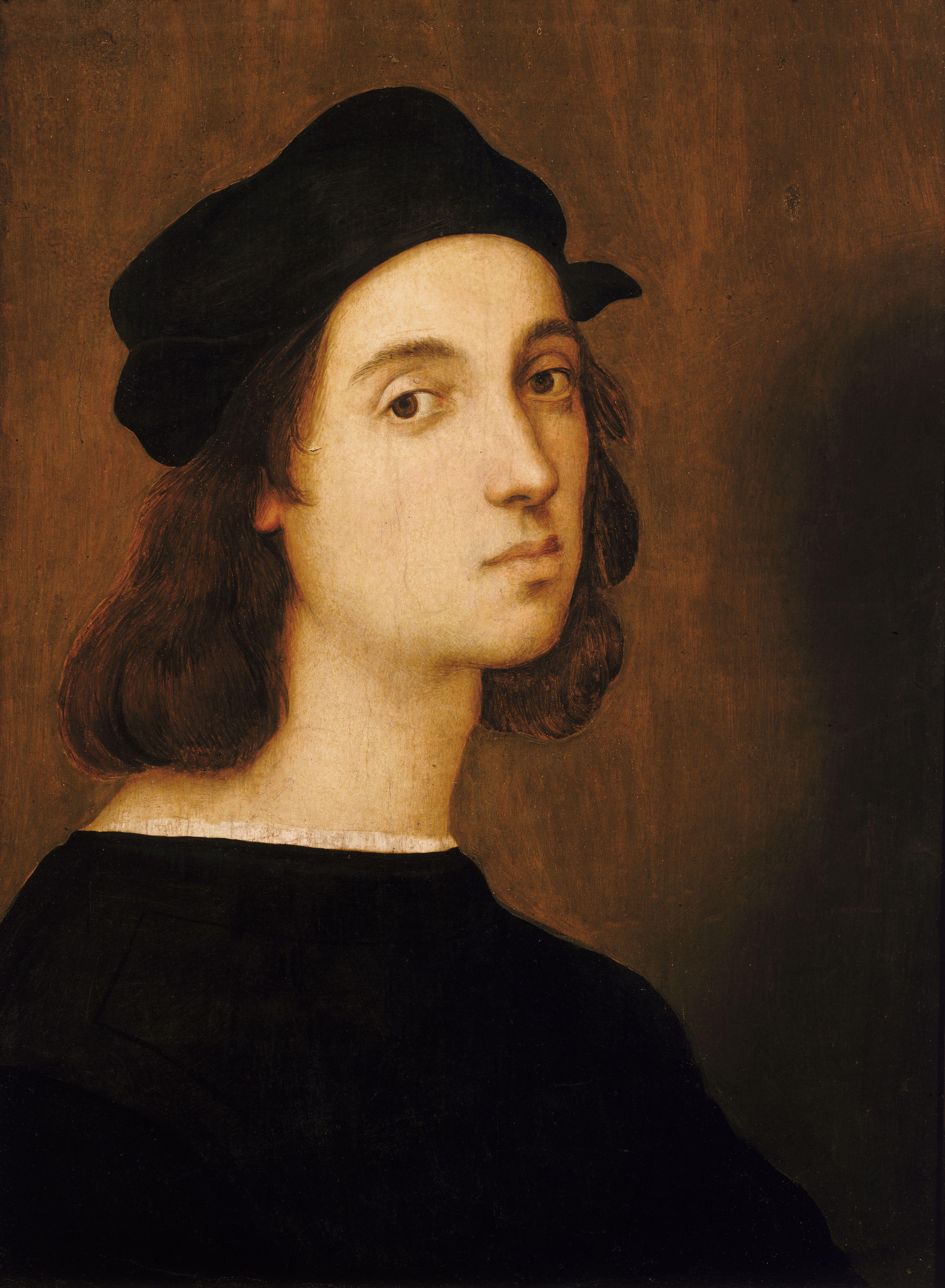
Where Michelangelo brings thunder, Raphael delivers composure. His School of Athens stands as one of the clearest statements of Renaissance humanism ever painted. Philosophers gather in balanced symmetry beneath classical architecture. Gestures direct your eye effortlessly. Every figure occupies space with calm certainty.
Raphael mastered pyramidal composition: a stable triangular structure that conveys order and authority. Unlike Michelangelo’s tension or Leonardo’s mystery, Raphael offers equilibrium.
That balance matters. It signals cultural confidence. It suggests a world where intellect, art, and architecture align seamlessly. In many ways, Raphael defines the visual language of leadership: centered, composed, and intellectually grounded.
Titian and the Venetians: Color as Power
Move north to Venice, and the Renaissance shifts tone. While Florence and Rome emphasized line, structure, and anatomy, the Venetians, especially Titian, elevated color to an art form in its own right.
Silks shimmer. Skin glows with warmth. Backgrounds dissolve into rich, atmospheric hues. Portraits radiate texture and luxury. Venetian painters understood surface: how fabric falls, how jewels catch light, how deep ultramarine or crimson communicates wealth and prestige.
Consequently, Titian’s portraits feel less architectural and more sensorial. They shaped European ideas of opulence, aristocratic presence, and visual indulgence.
If Florence perfected proportion, Venice perfected atmosphere. That atmosphere continues to inform luxury branding, interior design, and fashion photography today.
The Northern Renaissance: Detail as Devotion
Meanwhile, north of the Alps, artists such as Jan van Eyck and Albrecht Dürer approached the Renaissance in different ways. Rather than monumental bodies or sweeping frescoes, they pursued microscopic precision.
Textures astonish. Fur looks tangible. Metal reflects realistically. Tiny objects, like a candle, a dog, or a book, carry layered symbolism. Every inch of the canvas invites scrutiny.
Where Italian masters often dramatized form, Northern painters intensified detail. They embedded meaning in material reality. The result? A complementary vision of Renaissance intelligence: not only grand theory and classical revival, but careful observation of everyday life.
Taken together, these masters form a spectrum of Renaissance identity:
- Leonardo represents inquiry.
- Michelangelo represents strength.
- Raphael represents harmony.
- Titian represents sensual luxury.
- The Northern artists represent precision and symbolism.
Understanding them is not about memorizing dates. Rather, it’s about recognizing the foundations of modern visual literacy and seeing how those ideals of intellect, power, refinement, and detail continue to shape how men present themselves to the world today.
How to Actually Read a Renaissance Painting

Most men walk into a gallery, glance at a Renaissance painting, and either nod respectfully or move on. However, the real reward comes when you learn to read the image the way the artist intended.
Renaissance painters were not improvising. They were directing your gaze intentionally. Consequently, once you know what to look for, you stop seeing “a religious scene” or “an old portrait” and begin to see strategy.
Follow the Director’s Cues: Hands, Eyes, and Gesture
First, think like a filmmaker. Before you absorb the colors or the costumes, ask yourself: where are the figures looking? Whose hand directs the action, and in what direction? Which bodies lean forward with urgency, and which pull back in restraint? Renaissance artists didn’t scatter attention randomly; rather, they choreographed it with precision, using gesture as their primary tool.
Hands, in particular, are rarely incidental. On the contrary, they often carry the narrative weight of the scene. A raised finger can signal authority, revelation, or divine connection. An open palm may communicate invitation, humility, or surrender. Meanwhile, crossed arms frequently suggest tension, skepticism, or guarded emotion. In effect, the hands speak as clearly as the faces.
Similarly, eye lines operate like invisible arrows embedded in the composition. When several figures direct their gaze toward a single individual, your attention follows almost automatically. For example, in scenes such as The Last Supper, every gesture and glance ultimately converges on Christ. Notably, this focus is achieved not through dramatic color shifts or theatrical lighting, but through disciplined visual orchestration.
In other words, the painting guides your attention the way a great director guides a camera: subtly, deliberately, and always with purpose.
Decode the Symbols: Nothing Is Random
Next, shift from movement to meaning. Renaissance art thrives on symbolism. Objects often convey layered meanings, particularly in religious or mythological works.
- Animals: A dog can symbolize loyalty. A lamb may represent sacrifice.
- Fruit: Pomegranates can signal resurrection. Apples often suggest temptation.
- Skulls: A reminder of mortality—memento mori.
- Books: Learning, scripture, or intellectual virtue.
- Flowers: Purity, passion, or transience, depending on type.
Even small objects matter. A broken column, a cracked stone, a subtle shift in lighting are details that often signal narrative turning points. Therefore, rather than asking, “What is this painting about?” ask, “Why is that object there?”
Read the Clothing: Fabric Is a Language
Then, consider fashion: not as decoration, but as biography. Renaissance society was deeply hierarchical, and clothing reflected power. Ultramarine blue (made from lapis lazuli) was more expensive than gold. Silk, velvet, brocade, and fur signaled wealth and status. Armor suggested martial virtue. Jewelry implied political alliances or family prestige.
Consequently, portraits functioned much like modern branding campaigns. Patrons commissioned images not merely to be remembered, but to control how they were remembered. Notice how fabric folds catch light. Observe how armor gleams. Study the precision of tailoring. Renaissance painters treated clothing as a declaration of authority.
In this sense, reading a Renaissance portrait isn’t unlike assessing a tailored suit today. Cut, material, color, and posture communicate ambition before a single word is spoken.
Recognize Compositional Authority
Beyond symbols and fabric lies structure. Renaissance compositions often rely on symmetry and geometric stability. Pyramidal groupings: where figures form a triangular shape, create balance and hierarchy. Architectural framing (arches, columns, domes) reinforces authority and order. Symmetry conveys control. Central placement signals importance. Elevated positioning implies moral or spiritual dominance.
Thus, composition itself becomes a statement: this is a world governed by proportion, hierarchy, and reason. When you begin to notice these structures, paintings no longer feel chaotic. They feel engineered.
A Repeatable Viewing Ritual
Finally, adopt a simple ritual every time you stand before a Renaissance work.
Step Back First
From a distance, assess mood, composition, and balance. Who dominates? Where does your eye land? What’s the emotional temperature?
Then Move Closer
Study texture, brushwork, details, and symbols. Examine how light transitions across skin. Notice cracks in stone or reflections in metal.
This two-step approach, macro to micro, transforms passive observation into active interpretation.
Ultimately, learning to read Renaissance art is less about memorizing facts and more about training perception. You begin to notice intention. You detect hierarchy. You sense craftsmanship. And once you develop that habit of looking closely and decoding gesture, structure, and symbolism, you don’t just read paintings differently. You read the world differently.
Why Renaissance Art Belongs in a Men’s Lifestyle Conversation
If Renaissance art feels distant, with its gold frames, hushed museums, and Latin inscriptions, it’s worth reconsidering. Because, in truth, much of what modern men value in fitness, style, ambition, and travel traces directly back to Renaissance ideals. Understanding that lineage doesn’t make you pretentious. It makes you perceptive.
The Renaissance Body and the Modern Ideal
To begin with, consider the male form. Michelangelo’s David is not merely a sculpture; it’s an anatomical manifesto. Broad shoulders, a defined torso, and a poised contrapposto stance. The Renaissance elevated the disciplined, proportioned body as a symbol of strength, intellect, and civic virtue.
Sound familiar? Today’s fitness imagery, whether in sports campaigns, tailoring ads, or fragrance editorials, echoes that same architecture. Balanced proportions. Controlled posture. Strength without distortion.
Similarly, grooming ideals draw from this visual heritage. Clean lines. Structured hair. Intentional presentation. The Renaissance body was about cultivated form. In other words, the modern aesthetic of masculine composure has deep roots in Renaissance thought: the body as an instrument of discipline and self-mastery.
Art as Power Branding
However, the Renaissance wasn’t only about physiques and perspective; it was about projection. Powerful families like the Medici commissioned works not out of idle generosity but as a form of strategic branding. A chapel fresco was more about messaging than decoration. A portrait signaled lineage, wealth, intellect, and taste.
In many ways, Renaissance patronage functioned like a 16th-century Instagram feed: carefully curated, highly visible, and designed to shape perception. Likewise, modern men build reputations through curated spaces: homes, offices, wardrobes, and social media presence. The principle remains the same. Aesthetic choices communicate values.
Understanding Renaissance art sharpens that awareness. You begin to recognize how imagery constructs legacy. And that recognition informs how you construct your own.
Travel and the Discipline of Slow Looking
Furthermore, Renaissance art transforms travel from tourism into immersion. Florence is no longer just “Italy.” It becomes the birthplace of perspective. Rome is a living archive of papal ambition and artistic rivalry. Even London and Paris house Renaissance works that anchor entire museum wings.
Planning a “Renaissance art day” in a city: Florence’s Uffizi, Rome’s Vatican Museums, Paris’s Louvre, creates structure in travel. It slows you down. It shifts you from checklist tourism to intentional exploration. And importantly, slow looking builds mental stamina. Spending fifteen focused minutes in front of a single painting trains attention in a world that constantly fragments it. Travel, then, becomes both escape and refinement.
Social Fluency and Cultural Leverage
Finally, art literacy carries a quiet social power. Recognizing a Raphael or casually explaining linear perspective during a museum visit signals curiosity and range. It elevates dinner conversation. It deepens dating experiences. It adds dimension to business travel. More importantly, it allows you to move fluidly between worlds: boardrooms and galleries, fitness and philosophy, aesthetics and ambition. Cultural fluency demands genuine engagement, which translates into confidence that feels earned rather than performed.
Ultimately, Renaissance art belongs in a man’s lifestyle conversation because it shaped the blueprint for modern masculinity: disciplined body, cultivated taste, strategic image, and intellectual curiosity. The Renaissance man wasn’t defined by one skill. He was defined by integration. Strength and sensitivity. Ambition and artistry. Structure and imagination. That synthesis still defines the most compelling men today.
Getting Started: A Practical Renaissance Art Hit List
Understanding Renaissance art doesn’t require a graduate degree. Instead, it requires structure. With the right entry points and a disciplined approach to looking, you can begin developing visual fluency immediately. The key is intentional exposure, not volume.
Start With a Focused Viewing List
Rather than attempting to “cover” the Renaissance, begin with a short, strategic selection of masterworks. Each of the following offers a distinct lens into the period’s ideals of proportion, power, intellect, and luxury.
Michelangelo – David (Galleria dell’Accademia, Florence)

First, step back and take in the posture. Notice the weight shift in the hips and the tension gathering in the right hand and neck. Then consider the expression. Is the figure calm, or preparing for conflict? This sculpture embodies poised strength rather than theatrical aggression.
Leonardo da Vinci – Mona Lisa (Louvre, Paris)

At first glance, the painting appears understated. However, examine more closely the subtle modeling of light around the eyes and mouth. Observe how the background landscape dissolves into atmospheric distance. Leonardo isn’t simply rendering a portrait; he is constructing psychological depth.
Leonardo da Vinci – The Last Supper (Santa Maria delle Grazie, Milan)

Begin by locating the vanishing point directly behind Christ’s head. Then follow the chain of gestures among the apostles. Each reaction builds a wave of tension outward from the center. Here, geometry and narrative operate as one system.
Raphael – The School of Athens (Vatican Museums, Rome)

Notice the architectural framing—arches that guide your eye toward the philosophical dialogue at the center. Plato gestures upward, Aristotle outward. Balance and proportion create intellectual authority.
Titian – Venus of Urbino (Uffizi Gallery, Florence)

Shift your attention to color and texture. Observe the richness of the fabric, the softness of the skin, and the contrast between the foreground and the background. This painting explores sensuality, wealth, and domestic power with unapologetic confidence.
Deepen Your Visual Literacy
Once you’ve engaged with a few works directly, expand your understanding with accessible guides rather than dense academic texts.
- Patrick de Rynck, How to Read a Painting – A practical framework for decoding symbolism, composition, and visual storytelling.
- Museum-published Renaissance surveys (The National Gallery, The Met, The Louvre) – Concise, well-illustrated, and grounded in curatorial expertise.
Importantly, the objective isn’t memorization. Instead, it’s pattern recognition. Over time, you’ll begin to spot recurring compositional structures, symbolic cues, and stylistic signatures instinctively.
A Repeatable 15-Minute Viewing Practice
To convert passive looking into active analysis, implement a simple ritual:
- Select one Renaissance painting.
- Spend the first few minutes observing from a distance. Identify overall composition, dominant shapes, and emotional tone.
- Then move closer. Study hands, eyes, fabric textures, architectural details, and transitions in light.
- Finally, ask yourself what narrative or value system the image promotes.
Fifteen uninterrupted minutes often reveal more than a rushed museum tour.
The Strategic Advantage of Attention
Ultimately, Renaissance art rewards deliberate focus. It refines perception, strengthens analytical thinking, and sharpens aesthetic judgment. Moreover, the discipline of slow looking mirrors broader principles of mastery. Whether in fitness, leadership, or style, authority emerges from attention to detail. To see what others miss is not a matter of intelligence alone. Rather, it is the result of cultivated observation. In that sense, engaging with Renaissance art becomes a form of training for a more perceptive, composed, and intellectually grounded life.