

Street Art and the City: From Graffiti Roots to Global Influence
Street art is a form of public communication, one of the few visual languages that operates entirely outside the gallery, the museum, and the collector’s wall.
Walk through any major city, and you will encounter it: a stenciled figure on a concrete wall, a floor-to-ceiling mural on a building that was grey last month, a wheatpasted poster half-torn by weather. Street art is visual art created in public spaces. It’s often unsanctioned, occasionally commissioned, and almost always intended for an audience that did not seek it out.
To be clear, this is not decoration. Street art is a form of public communication, one of the few visual languages that operates entirely outside the gallery, the museum, and the collector’s wall. It surfaces in the places people actually move through: commutes, neighborhoods, vacant lots, transit stations. It speaks to people who would never buy a ticket to an exhibition. That accessibility is not incidental. It is the point.
Understanding street art means understanding the culture that produced it, from its origins in rebellion, its evolution into a global movement, and its ongoing tension between art and law, between community voice and property rights. More importantly, it means recognizing why it continues to matter, even after decades of institutional acceptance.
The Origins of Street Art

The impulse to mark public surfaces is as old as human civilization. From cave paintings to Roman graffiti and medieval inscriptions, the desire to leave a visible trace in shared space runs through every era of recorded history. But modern street art as a cultural force has a more specific origin point.
Contemporary street art and graffiti emerged in the late 1960s and early 1970s, with New York City as the undisputed center of the movement. At that moment, the city was in significant distress. It was experiencing economic decline, social unrest, budget cuts to school arts programs, and a generation of young people found their creative outlet not in classrooms but on walls.
It began with tagging: writers marking their names across as many surfaces as possible. The most influential early figure was TAKI 183, a teenager from Washington Heights who began tagging his name and street number across all five boroughs in the late 1960s. His reach was prolific enough that the New York Times ran a story tracking him down in 1971, inadvertently bringing an underground subculture into mainstream awareness for the first time.
What followed was rapid and competitive escalation. The rise of hip-hop culture in the 1970s further cemented graffiti’s role as a cornerstone of urban identity. Alongside breakdancing, DJing, and rap, it gave marginalized communities a creative language that was entirely their own. New York’s subway system became the movement’s most powerful canvas: mobile, city-wide, and impossible to ignore. By the early 1980s, graffiti had moved from tags to full elaborations, with complex lettering, characters, and scenes that covered entire train cars.
Street Art vs. Graffiti
Although the terms are often used interchangeably, graffiti and street art are distinct forms of urban expression. Graffiti typically focuses on stylized lettering, symbols, or tags, emphasizing the artist’s identity or crew affiliation. Street art, by contrast, encompasses a broader range of visual expression that includes murals, stencils, wheatpaste posters, and installations, which often engage with social or political themes and are sometimes produced with property owners’ consent.
In other words, graffiti is a specific practice within the wider umbrella of street art. A tag is graffiti. A commissioned mural depicting a neighborhood’s history is street art. Many works fall somewhere between the two, which is part of what makes the boundary so culturally interesting.
The distinction also carries legal and commercial implications. Commissioned street art has moved into festival programming, brand partnerships, and public arts funding. Graffiti, in its unsanctioned form, remains illegal in most jurisdictions. That split, between recognized art and criminal act, runs through every serious conversation about the medium and its place in public life.
Why Street Art Matters Culturally

Street art has always functioned as a form of social commentary. Its placement in public space is what gives it authority. A painting in a gallery reaches people who choose to engage with art. A mural on a building in a working-class neighborhood reaches everyone who passes it, regardless of whether they would set foot in a gallery.
At the same time, street art reflects identity and community voice in ways that institutional art often cannot. When a neighborhood’s walls carry images of its history, its residents, its struggles, and its pride, those walls become a form of self-representation. The art was not commissioned by a distant institution. It emerged from the place itself.
More importantly, street art has consistently transformed neglected spaces. Vacant lots, shuttered storefronts, and deteriorating infrastructure become something else when painted with large-scale work of genuine quality. The transformation is not merely aesthetic. It signals investment, community attention, creative energy, a refusal to accept decline as the final condition of a place.
Ultimately, that combination of social commentary, community voice, and physical transformation is what separates street art from mere decoration. It is a living record of what a city thinks about itself at a given moment.
Major Artists and Influences

Street art’s transition from underground subculture to a global movement occurred through individual artists whose work was compelling enough to cross into mainstream awareness. Several figures are worth knowing.
Keith Haring
Keith Haring emerged from New York’s downtown art scene in the early 1980s, chalking figures in subway stations before moving to gallery walls and public murals. His visual language consisted of bold outlines, radiant figures, and cartoonish simplicity. It was instantly legible and deeply intentional. He died of AIDS in 1990 at 31, but his work remains among the most recognized in the history of public art.
Jean-Michel Basquiat
Jean-Michel Basquiat began his work as a graffiti writer under the tag SAMO, spraying cryptic phrases across Lower Manhattan in the late 1970s. Then, he moved into painting and gallery representation with unusual speed, becoming one of the most celebrated artists of his generation before his death at 27. His work was raw, layered, and furious, and remains the clearest example of how graffiti’s energy could be translated into fine art without losing its edge.
Shepard Fairey
Shepard built his career through the Obey Giant campaign, which began in 1989 with stickers and wheatpaste posters bearing a stylized image of wrestler André the Giant. The campaign’s ironic tone, which marketed itself as propaganda to critique the nature of propaganda, was prescient. His 2008 Hope poster, created for Barack Obama’s presidential campaign, became one of the most recognizable political images of the era.
Banksy
Banksy still remains anonymous, which is itself a statement. His stenciled work is politically charged, often sardonic, and placed with calculated precision on the walls of cities worldwide, making him the most discussed street artist alive. The fact that his identity remains unknown has not prevented his work from selling at auction for millions. His pieces address war, consumerism, surveillance, and inequality with an economy of image that is as disciplined as it is provocative.
JR
JR works at a different scale. His large-format portraits of ordinary people, pasted onto buildings, bridges, and walls in communities around the world, function as an act of radical visibility. His project on the US-Mexico border fence, which pasted giant faces of Mexican citizens visible from both sides, remains one of the most powerful public art interventions of the past twenty years.
Together, these artists moved street art from the margins into the cultural center without, notably, making it safe or neutral in the process.
Street Art Today
The scale of street art has expanded considerably. Where early graffiti operated in the margins, in train yards at night, alleyways, or spaces below eye level, contemporary public murals now often cover the entire facades of multi-story buildings. As a result, festivals like Worldwide Walls and Art Basel’s public programming have turned mural-making into a global event circuit, bringing internationally recognized artists to cities that commission large-scale work as a deliberate investment in place identity.
Technology and the Expanding Canvas
Beyond scale, the intersection with technology is the most significant recent development. Augmented reality has begun to layer digital experience directly onto physical murals. Pointing a phone at a painted wall can now trigger animation, sound, or interactive narrative. For instance, Italy’s Museum of Augmented Urban Art has transformed over one hundred murals into animated digital works accessible via a smartphone app. Building on that, cities like Berlin and Tokyo have taken the concept further, using AR murals to turn entire neighborhoods into immersive environments that exist simultaneously in physical and digital space.
Materials with a Message
At the same time, sustainability has entered the conversation. Artists in 2026 are increasingly working with non-toxic, biodegradable, and air-purifying paints, including moss-based graffiti that grows into living letters and photoluminescent pigments powered by sunlight. The streets, which have always spoken about the state of the world, are now doing so with materials that reflect environmental intention. More importantly, this shift signals something larger. Street art is no longer simply a response to urban neglect. It has instead become a medium through which cities think about themselves: their history, their politics, their relationship to technology and the environment, in real time and in public.
The Legal and Ethical Debate
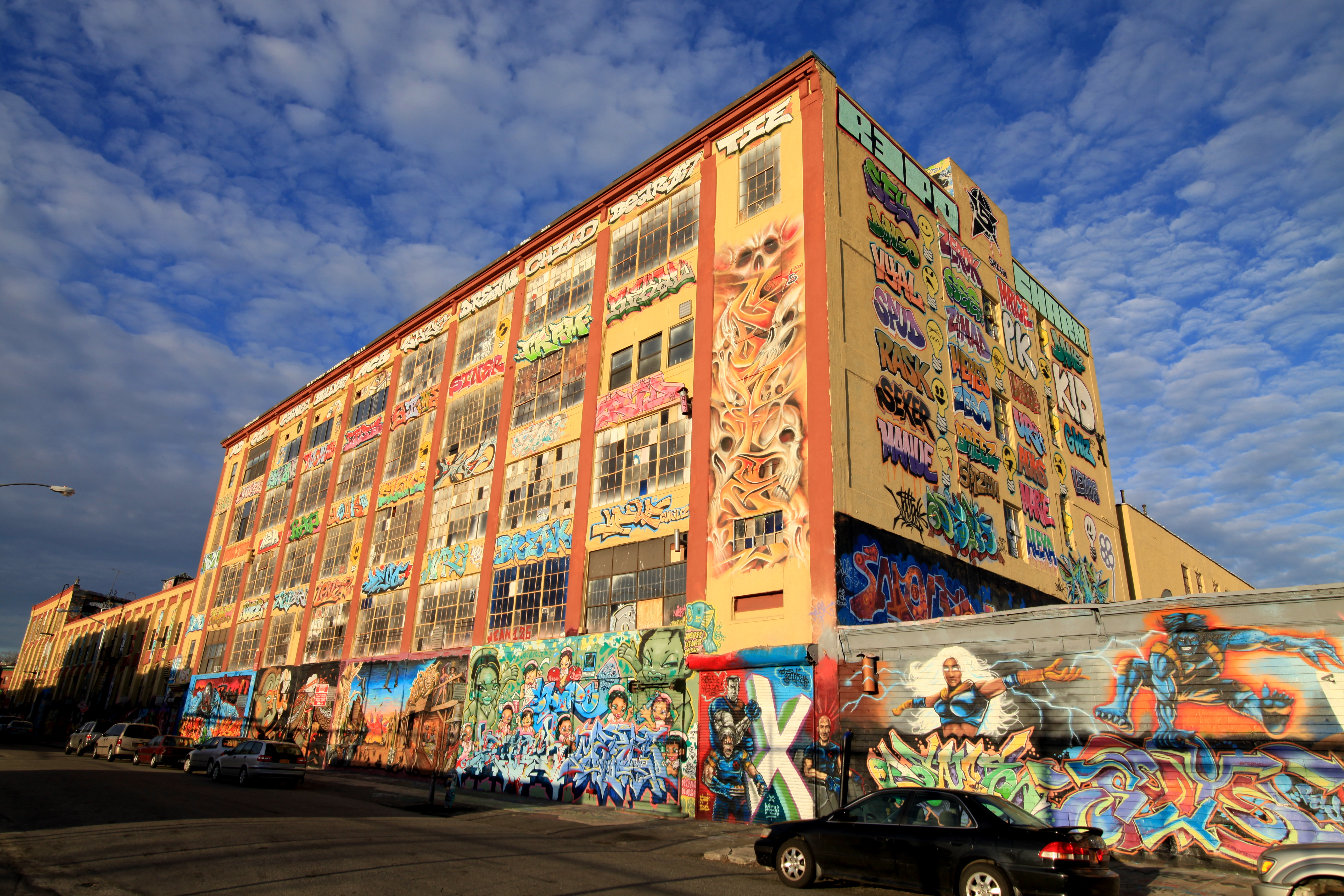
The tension at the center of street art has never been fully resolved. On one side sits the property owners’ right to control what appears on their buildings. On the other hand, the claim that art created in public space for a public audience carries its own legitimacy, regardless of permission. To begin with, these two positions are not easy to reconcile, and the law has struggled to do so for decades.
Copyright and the Grey Area
Under US copyright law, a work receives protection as soon as it is fixed in a tangible medium, which technically includes paint on a wall. Even so, unsanctioned street art exists in a legal grey area: painting without permission invites counterclaims that can complicate or defeat an artist’s copyright assertion. As legal scholars have noted, copyright law differentiates between the physical fixation of a work and the artist’s expression. This means that the illegality of the act does not automatically void the copyright, but it does, nevertheless, create significant friction.
The 5Pointz Ruling
The 5Pointz case in New York brought these tensions into sharp relief. When a developer whitewashed a celebrated collection of murals in Long Island City in 2013, artists successfully sued under the Visual Artists Rights Act, winning $6.75 million in damages. As a result, the ruling established that street art could carry legally recognized moral rights, a significant shift from the earlier view that unsanctioned work was simply vandalism with no standing in court.
A Shifting Legal Landscape
Building on that precedent, a 2024 ruling in Tel Aviv found that street artists’ murals were entitled to copyright protection, further strengthening the status of street artists as individuals with recognized rights over their work. The legal landscape is moving, slowly, toward greater recognition. Though ultimately, the fundamental tension between expression and property has not disappeared.
The Preservation Problem
Beyond copyright, preservation presents a separate but equally complex issue. Street art is by nature impermanent, subject to weather, development, and deliberate removal. When a Banksy appears on a wall in Bristol, for instance, the local government now faces a genuine question: protect it or permit its removal? The old answer that it was vandalism and should be removed is no longer straightforward when the work in question may carry significant cultural and financial value.
Street Art Decoded

What Are the Three Types of Street Art?
The most commonly recognized categories are murals, stencil art, and wheatpaste.
- Murals are large-scale painted works applied directly to a wall surface. It’s the most labor-intensive form and the one most likely to be commissioned.
- Stencil art uses pre-cut templates and spray paint to create repeatable images with clean edges and fast execution; Banksy built his entire career on the precision and speed the technique allows.
- Wheatpaste involves printing an image on paper and adhering it to a surface with paste. This is a method that allows for photographic detail and large formats at relatively low cost, and one that JR has used to paste giant portraits onto buildings, bridges, and border walls worldwide.
Beyond these three, the broader category also includes tagging, tile mosaics, yarn bombing, and projection art, but murals, stencils, and wheatpaste form the core vocabulary most people encounter in any major city.
What Is Another Name for Street Art?
The most common alternative term is urban art, which tends to carry slightly more institutional weight. It is the language that galleries, festivals, and public arts commissions use when they want to acknowledge the form without the associations that come with the word “street.” Public art is the broader umbrella term, though it typically implies commission and sanction rather than the unsanctioned origins that define much of the tradition.
Graffiti is sometimes used interchangeably with street art, though the two are technically distinct. Graffiti refers specifically to text-based tagging and lettering, while street art encompasses the full range of visual expression in public space. In academic and curatorial contexts, you will also encounter post-graffiti, which describes the evolution of the form from unsanctioned writing into the wider movement it has become.
What Is Street Art vs. Graffiti?
The distinction is real, though the boundary between them is deliberately blurry, and that ambiguity is part of what makes the conversation interesting. Graffiti, in its original and most precise sense, refers to text-based work: tags, throw-ups, and pieces that emphasize the writer’s name, identity, and crew affiliation. The craft lies in the lettering, its style, complexity, and placement.
Street art, by contrast, encompasses a much broader range of visual expression: murals, stencils, posters, installations, and mixed-media work that often engages with social, political, or community themes. Street art frequently aims to communicate with a general audience rather than within a subculture. In practice, the two traditions overlap considerably. Many artists work in both registers, and the most interesting work often sits at the boundary. They carry the energy and placement logic of graffiti while communicating at the scale and legibility of public art.
What Is the Most Famous Piece of Street Art?
By most measures, Banksy’s Girl with Balloon, a stenciled image of a young girl reaching toward a red heart-shaped balloon, is the most recognized piece of street art ever made. It first appeared on London’s South Bank in 2002 and has since been reproduced, referenced, and reinterpreted worldwide. In 2018, a canvas version sold at Sotheby’s for £1.04 million and immediately shredded itself through a mechanism hidden in the frame, an act Banksy later revealed he had built years earlier.
The shredded version, renamed Love is in the Bin, was subsequently sold for £18.6 million in 2021, making it one of the most valuable works ever produced by a street artist. The piece is a useful reference point precisely because it captures everything that makes street art culturally significant: accessibility, provocation, humor, and a fundamental challenge to the institutions that assign value to art in the first place.
The Future of Street Art
Street art remains a living, changing form of culture that is not fixed in a gallery or a collection. It is exposed to weather, urban development, deliberate removal, and the ongoing pressure of a city that is always remaking itself. That exposure is not a weakness, but is part of what gives street art its urgency.
The power of the medium comes from its visibility, its immediacy, and its connection to everyday life. It is encountered without choice, on the way to work, on the wall of a building you walk past every morning, demanding your attention.
As technology continues to expand the canvas from painted walls into augmented digital layers, and as cities increasingly recognize street art as genuine cultural infrastructure, the medium will continue to evolve. What will not change is the fundamental impulse behind it: the need to mark shared space with something meaningful, to make the city speak. That impulse is as old as the first mark on a cave wall. The spray can, the stencil, and the smartphone are simply the latest instruments it has found.